17 August 2003
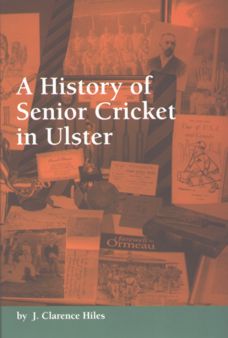 Everybody interested in Irish cricket will want to read this definitive history of cricket in Ulster. Produced after 14 years of painstaking research by author Clarence Hiles, this handsome 400 page volume is clearly written, packed with interest and beautifully presented. But it is more than just a chronology of matches and peronalities, as the book's foreword by Ian Callender explains.
A History of Ulster Senior Cricket costs 18.95 plus 2.50p&p and can be ordered by email from clarence.hiles@ntlworld.com
Foreword by Ian Callender
When Clarence Hiles, an Ulsterman born and bred, left the Province for a new life in 1996 it was never going to be a case of out of sight, out of mind. Clarence isn't that type of person. Long before he returned his beautiful wife, Pamela, to her native coun try he was deep into the first draft of this book. Almost 14 years in creation, it has been a labour of love for a man who has been omnipresent in Northern Ireland cricket for a generation.
His move to foreign shores could hardly have been better timed because it was at about the same period that the worldwide web was becoming more and more popular. So, rather than losing touch with cricket in England, or even Ireland, he was only the click of a mouse away, keeping up to date with events worldwide especially in and around his home town of Comber.
He has never lost touch with home as Malcolm Brodie, former sports editor of the Belfast Telegraph, still sends him a copy of Ireland's Saturday Night every week, his most eagerly awaited postal delivery.
When I started writing cricket for the now defunct Sunday News in the early 1980s, Clarence was North Down's opening bowler, never threatening to become a leading light on the field but, just as I enjoyed writing about the game rather than playing, he was never satisfied just to turn up on a Saturday and disappear until the next game.
He was always going to be involved off the field and as a Northern Cricket Union executive member and delegate to the Irish Cricket Union, he got an inside track on the state of cricket throughout the country. He was rarely impressed and frequently was a lone voice in trying to move things forward, much quicker than his contemporaries wanted.
As a journalist Clarence was a dream contact. First, and foremost, he appreciated that the media was an indispensable part of cricket so he was always willing to help me in my early days and, even more importantly, knew what the media wanted and how it worked.
So it was not surprising to see him become an honorary member of the Fourth Estate sooner rather than later. It was 1985 that the Ulster Cricketer brought the sport in Northern Ireland on to a new level. Here was a man prepared to produce a bi-annual publication, virtually single-handed, with little indication that there was a market out there to support such a magazine.
Cricket in the Province, at that time, was very much a minor sport, struggling for space in newspapers and on radio or television. The international team was still almost 10 years from appearing on the world stage and the only glamour match of year was the one-day NatWest Trophy tie. Appearances of a Test side making a cursory visit to Ireland was every other year, if we were lucky.
The Ulster Cricketer proved the demand was there and, even now, anyone with a full collection of back issues will have an unparalled and detailed guide to the development of cricket in the Province over an 11-year period. The format was simple but it worked. The spring issue was a preview of the forthcommg season, the autumn issue was a review. Deadlines were not always met but no matter when it hit the bookshelves it was an essential read for anyone with an interest in the premier summer team sport.
His list of contributors was a who's who of world famous names. For example, the winter 1993-94 issue had articles by (then Prime Minister) John Major, Jeffrey Archer and Trevor Bailey and all the big names of Irish cricket regularly gave their views. His emigration to the Caribbean brought the curtain down on the publication and, with no one around to take up the mantle it is still much missed.
In 1986, Clarence Hiles edited the centenary brochure of the Northern Cricket Union, then the definitive history of cricket in Ulster. Little did anyone know then but that 84 page publication was to be the forerunner of this massive and comprehensive tome.
Clarence claims in his introduction that the book is not a "voluminous all-embracing authorative chronicle of everything that moulded the development of cricket in Ulster". I'm not so sure. It may be a personal perspective but as he was only born 149 years after the books beginning, his research has been, quite simply, indefatigable. It is hard to find anything that has been neglected, from the state of the world at the time to every aspect of cricket in the NCU, North West and, indeed, in relation to the Irish Cricket Union. The reluctance of the Ulster unions to have any part in an ICU in the early years is very revealing and its progress to the much-improved relationship in existence today is faithfully recorded.
Personalities leap out of page and everyone of note from Bishop HH Montgomery to Dermott Monteith to Decker Curry have a chapter to themselves. Clarence's empathy for North West cricket is legendary He always thought they got a raw deal and his decision to present monthly awards for the Player and Team of the Month, which continues today with his former employers Britannia, were his way of ensuring that North West players were not forgotten in the Belfast-driven media. We are still awaiting the setting up of an Ulster League but the ClubTurf Ulster Cup is, surely, paving the way for such an eventuality
The statistics of the game are not neglected either and here, for the first time in one publication, are the scores, teams and venues of every domestic cup final over 115 years plus the Irish Senior Cup line-ups and a list of the 197 players from Ulster clubs who played for Ireland from 1855-2001. The list of 39 international umpires from Northern Ireland only underlines 'Hiler's' dedication to a project, which is guaranteed to be the definitive history of Ulster cricket for many years to come.
Somehow, I doubt if it will be Clarence Hiles' last work but his first major publication has set the standard if others attempt to follow and everyone with an interest in cricket must be thankful that the boy from Comber may, most of the time, now may be out of sight but deserves never to be out of mind.