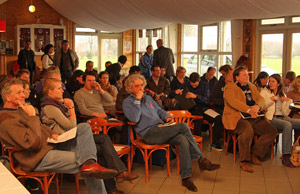
 It's one thing to write a plan; implementing it is the real test. And representatives of twenty Dutch cricket clubs began the task of turning the KNCB's Youth Plan into reality in Amsterdam on Saturday, at a launch which suggested that this could indeed be a turning-point in the history of the game in the Netherlands.
Welcoming the participants, chief executive Richard Cox described the past month as ‘perhaps the most significant in the Bond's history'. ‘Change can be difficult,' he said, ‘and some people may find it a challenge. But we have to become more competitive, we have to be more efficient, and we have to close the gaps between key people, to work more closely together.'
The KNCB's new agreement with ABN AMRO had created an entirely new framework, he argued, with an expanded programme of player contracts and bursaries offering a clear career pathway for talented young cricketers, and academy programmes providing a pinnacle for those who have distinguished themselves in the Dutch Lions.
But the real emphasis of the Youth Plan, and of Saturday's launch, is on expansion of youth cricket's base, nearly doubling playing numbers over four years, and Cox outlined a seven-step progression which he termed ‘the key to success': coach development; programmes in primary schools; work in secondary schools; the provision of quality club environments; regional co-operation; the Dutch Lions programme; and eventual progression to the national sides.
‘The plan is called "Developing Cricket Together",' Cox said, ‘and we need to develop ways of working together more effectively to bring about the change Dutch cricket needs.'
A series of speakers then outlined different aspects of the plan, before the participants split into four regional groups to develop more concrete proposals for the coming season, reporting back at the end of the afternoon.
Two of these sessions were led by the Bond's new Regional Development Officers, Hannah Hofman and Subir Shrestha, whose appointments don't start officially until next Wednesday but who now found themselves thrown in at the deep end.
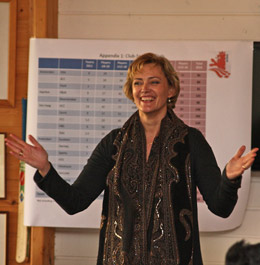 There was no mistaking the energy which was released in the room as the four groups of clubs sat down to compare notes, identify problem areas, and come up with innovative plans to expand and enhance youth cricket.
Regional competitions in Den Haag, Rotterdam and perhaps elsewhere; cricket weeks on the model of the one successfully held by the Voorburg club last year; the fielding of combined teams where clubs have insufficient youngsters in an age-group to go it alone; initiatives such as information evenings to get parents more involved; a more systematic approach to local schools; summer camps and regional specialist training sessions: the ideas which the plan had generated came from all corners of the room.
And the momentum created by the launch will not be allowed to dissipate, with all four regional groupings holding a further meeting in the next month to develop these ideas and begin putting them into practice.
It was a very positive start, but it would be a mistake to underestimate the challenges which lie ahead.
There was, inevitably, talk about the problems cricket faces from larger and increasingly predatory sports like football and hockey, and Cox himself had referred to the threat posed by a shift in policy by the Dutch national sports body, NOC*NSF, which is proposing to focus even more narrowly on sports where the Netherlands is among the top ten countries in the world, especially those which have a place in the Olympics.
There remains, too, the issue of the more than twenty clubs which were not present on Saturday, the majority which have no youth section, and in many cases no plan to develop one. If the new regional networks can reach out to them, encouraging them to take their share of responsibility for the future of Dutch cricket, then this will indeed prove to be an historic moment.
Even as it is, though, the Netherlands' young cricketers can look forward to a livelier, more intensive and more extended schedule than they have been offered in the recent past, and those who are about to be introduced to the game through projects like the Bilingual Schools' Challenge will be invited into a community which is serious about achieving success.