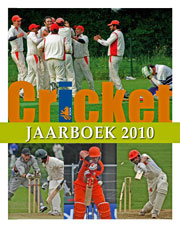
 One of the rare upsides of the latest freeze to hit Ireland was that I have been able to give my undivided attention to a review of the 2010 Netherlands Cricket Yearbook, which had dropped through my letterbox earlier in the week.
A 132 page bilingual publication (thankfully, otherwise it would have been the shortest review in history!), published with the help of the KNCB, the yearbook has been the culmination of a lot of hard work by the many contributors. I'm pleased to say that their efforts have been well worth it, and this reader has been given a fascinating insight into the world of Dutch cricket.
What is striking throughout the publication is the honesty of all involved- a rare commodity in the ICC version of 'The Wonderful World of Disney' cricketing world.
In the same way an alcoholic must first admit that he has a problem, a recurring theme is an acknowledgement from the Chief Executivedownwards that there are serious problems and concerns, and that these need to be remedied.
Editor Maarten Westermann kicks off with a review of the Topklasse, giving the reader a week-by-week account of the season as it progressed. Like many in the Netherlands I guess, the bizarrely constructed play-off system had me scratching my head! Who and why devised such a complicated scenario, I have no idea - did I detect the hand of my former calculus teacher? Thankfully from reading further along, it appears a solution is at hand.
CricketEurope's very own Rod Lyall then interviews CEO Richard Cox on his first year in charge. Spread over four pages, one gets an in depth feel for the man entrusted with keeping The Netherlands at the top table of Associates cricket. One of the strengths of the yearbook is the volume of pages allows the author and reader to get a wide ranging interview, with no questions left unanswered.
Cox makes no apology for the fact that he is still involved in the coaching side of things, and indeed does the odd spot of groundsmanship, after opinions from the Dutch cricketing sphere that he should be concentrating on more matters worthy of a CEO.
I often remark that I feel the Netherlands are 4-5 years behind Ireland in terms of their development. The issue of player contracts, sponsorship, expanded international playing schedules, importation of foreign based players etc read like the Irish agenda of circa 2005-2007.
The honesty theme continues when Cox brutally admits that the current crop of Dutch youngsters simply isn't good enough, and makes no apologies for the recruitment of Australian Tom Cooper into the side, citing that 'we don't really have a choice at the moment.'
On the positive side Cox points to the wins over Bangladesh and Derbyshire as highlights, while the growth and success of the Dutch Lionesses gives him particular pride.
The lack of a headline sponsor on the eve of the World Cup must be a major concern for the CEO, and one feels that if Dutch cricket is to go to the next level, they are going to need a major injection of funding.
The affable Ruud Onstein then takes us on a global journey with the Dutch senior side in their 33 game odyssey. One can't help but feel the pain and the joy in his accounts of the highs and lows of the team during their most demanding season on record. Interspersed with comments from national coach Peter Drinnen, it gives the reader a unique view into the demands of what is still primarily an amateur team in a professional environment.
His tribute to Edgar Schiferli reminded me of the fact that I had stood just yards from him when he sustained the knee injury which ended his international career. Chasing the ball to the boundary in Dubai, a pretty innocuous looking slide ended up tragically for Schiferli. Just nine months previously I had photographed him in South Africa, where his Player of the Tournament award had been fully deserved for his bowling heroics - which secured a World Cup place in 2011.Ruud observes that 'to date, no successor of his quality has stepped forward.'
There was of course one young fast bowling prospect who had seemed capable of filling Schiferli's boots - Mark Jonkman. The difficult issue of the fast bowler's suspect action isn't ducked - another feature throughout of the yearbook - nothing is swept under the carpet. A bend in his action of between 31.4 to 38.8 degrees won't be easily remedied, and one can't help but feel he's been let down throughout his career that it's got to this stage - surely a player who has played at a high level for a number of years should have been spotted and fixed before now?
The continued woes of the Intercontinental Cup are well documented with perhaps my favourite line in the whole work - “Multi-day cricket and The Netherlands, it's not a happy combination.” You can say that again!
Ingrid van der Elst reviews the Dutch youth season and with just 9 wins in 35 games, it doesn't make for pretty reading. The positives and areas for remedy are well thought out, and every area is well covered. The progress of the Dutch Lionesses during the year brings happier news, and one can't help but feel that a real positive story is beginning to emerge in that particular sphere of the game.
The combative former skipper Jeroen Smits career is an entertaining read, and how he secured his 2003 World Cup place should be required reading for every young player aspiring to have an international career. A thoughtful and inspiring captain, I'll always remember his pre-match press conferences with the English media in the build up to the 2009 World twenty20. The same journalists who looked at him as if he had escaped from a mental asylum when he suggested that the Dutch could win, saw him in a different light post Lord's in June 2009!
There is a tribute paid to former Rod en Wit cricketer Hugo Nelissen, who died earlier this year at just 47 years of age, together with a moving poem by Erik van Muiswinkel, prominent cabaret artist and cricket enthusiast.
The Schiedam rivalry between Hermes and Excelsior is a wonderful read and the similarities between a derby in any country hold true. The sense of shame at a loss, and the euphoria in victory are well documented. Just how small the cricketing world is was brought home by the mention of former Excelsior professional Tony Opatha in the piece. The Sri Lanka also played as a professional for Eglinton in North West Ireland, and coached yours truly when just ten years old - (didn't do a great job I hear you say!). Opatha now runs a coaching academy in Colombo, and we came across him during the 2006 Under 19 World Cup.
A special prize for restraint should be given to Henk Kornet, who having acrimoniously switched allegiances, suffered the ignominy of a first ball duck on his return. As if that wasn't bad enough, he was escorted from the field of play by his former chairman holding a rubber duck and shouting 'quack, quack!!' He can at least now look back upon the incident and laugh.
National captain Peter Borren - the 2010 player of the year - gives a tough, straight talking interview - would you expect anything else? On the league play-off format - “confusing, unfair and strange.” The club versus country debate - “clubs are only concerned about themselves rather than international cricket.” His concerns about youth cricket and the standard of domestic cricket are well voiced, alongside with suggestions as to how both can be improved.
The emergence and growth of the Dosti cricket club is another fascinating read, and maybe offers a future solution in what seems to be an increasingly divisive domestic cricketing world in The Netherlands. The enthusiasm of club chairman Shyam Thewarie is infectious, and you can't help but hope his vision and dreams become a reality.
The four years of the Twenty20 Cup is examined, from its inception to what is by all accounts a well documented success, however it is quantified. 80,000 euros over the past four years certainly isn't small change, and in the present climate deserves the clubs serious attention. With the ICC plans to make Twenty20 the primary focus of the Associates worldly ambitions, expect this competition to expand and increase in importance.
There are six pages of photos documenting the various league and cup winners at all levels, which is a wonderful achievement. Indeed the book contains some wonderful images from 2010, and all credit must go primarily to Sander Tholen, Rod Lyall, and the ICC for their efforts.
The second section of the Yearbook is devoted to the Kleefstra Almanak, and its 56 pages contains every conceivable statistic relating to the Dutch cricketing year. A truly wonderful resource, and full credit to those involved in a very demanding and often soul destroying labour of love.
The 2010 KNCB Cricketing Yearbook is by no means a sycophantic back slapping publication. It covers difficult topics, asks and answers uncomfortable questions, and it is to be commended for that.
In his introduction KNCB Chairman Marc Asselbergs 'expects this book will prove a collector's item, as the first Cricket Yearbook in a long series.' I have a feeling he may well be right.
Anyone wishing to obtain a copy of the Cricket Jaarboek 2010, which will cost €19.50 plus packing and postage, should in the first instance e-mail Jeroen van Bergen at info@jeroenvanbergen.nl.